Thursday, September 2, 2010

A Strad Inspired Violin - Log 8/30/2010

Monday August 30th, 2010
Violin Restoration: From Broke to Baroque
The Work Begins

Ben is loosening the bottom bout rib from the back plate in the photo below.  Additional photos show steps in  working on the top plate.


Here Ben is using a chisel to cut away the top of the bass bar.


Once most of the bass bar is removed he switches to a small finger plane which he uses to remove the remainder of the bass bar and the glue which has held it to the top plate.  He uses this technique since the top plate is very thick and he plans to regraduate/thin it anyway.  In the case that the plate was not to be thinned he would use hot water to loosen and remove the last layer and glue.


Below Ben is checking the cracks on the top plate including the one on the lower bass bout which was repaired with cleats(lighter colored wood above his thumb) years before.  The small cleats used previously were not effective and the crack had reopened and will need to be repaired again.


Applying hot water Ben is cleaning the cracks.  


He has removed parts of the old cleats and glue as well as dirt from the cracks that were never repaired.  Below you can clearly see the separation needed so he can apply glue.


For final cleaning he will use water and soap which will cause the foaming seen below.


Before starting to glue the cracks he always does a test clamping to see how the parts will fit together and usually lets the cracks dry out while clamped..


Below he is applying glue to the top bout crack that had never been repaired.   He uses the old "brush and Finger" technique.  First applying the hide glue to the top of the crack with a brush as seen here.


Then he uses his finger to push the glue into the crack and clean the excess off.


On the under side of the plate he will remove excess glue that was forced through the crack from above.


Below the glued cracks are clamped for drying.  After all of the top plate cracks are glued solidly Ben can start the process of thinning/regraduating the thickness of the plate.  That will be at a later date.  When that process is complete however he plan to inlay and glue oval patch (like a sound post patch) much larger and more durable than the cleats used previously.


Sunday, August 29, 2010

A Strad Inspired Violin - Log 8/23/2010

Monday August 23rd, 2010
Violin Restoration: From Broke to Baroque

Some months ago I came across a very old broken fiddle that I was told would be cost prohibitive to repair and was not playable.  In fact, I was told if it had any value at all, it was as wall art.  The wood was very old and attractive as was the original carving of the top and bottom plates which when originally created were probably done by a luthier of some skill.  The instrument had a label that identified it as having been made by an Italian maker from Verona. The maker, Giacomo Zanoli, was not in Verona until after 1740. However, the label itself was nothing like labels of that maker and was probably a fake given that the date was too early for Verona and the spelling of the maker's name was usually Zanioli on original labels. The instrument itself I was told, did not have characteristics of construction or appearance of the Italian school but rather more likely Mittenwald, Germany as witnessed by the lack of mitering at the C-bout corners and shape, chamfering and position of the F holes as well as the position of the mensur marks.

The top bass side rib was a replacement not even constructed of maple nor properly bent to match the curve of the top plate.  The top plate was one piece construction with a number of previously repaired and unrepaired cracks that would have to be repaired or re-repaired to make the instrument playable.  


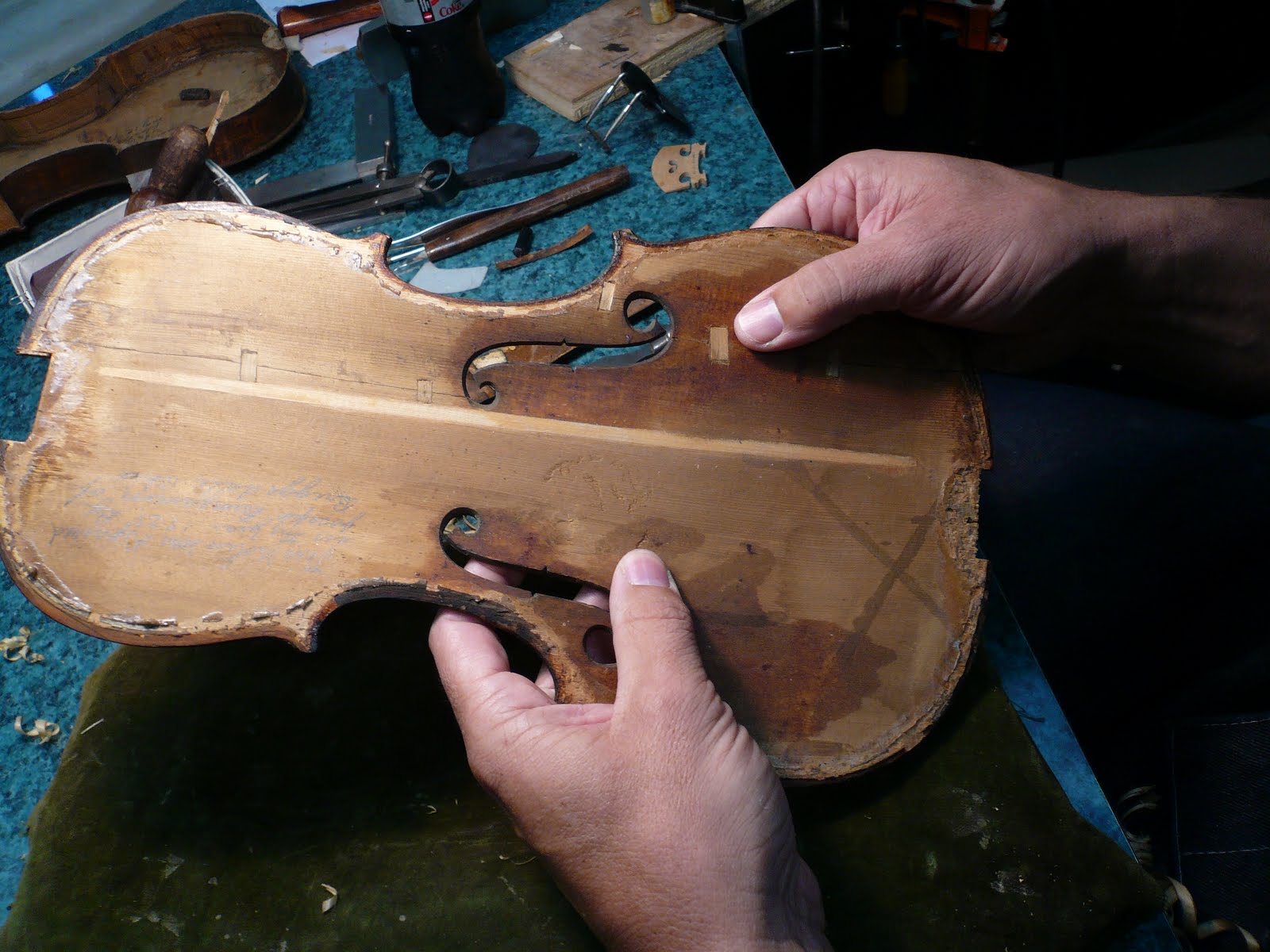
The bottom plate was from a single piece of maple with quite lovely flaming and unique in appearance.  However, someone had at one time attempted to clean the instrument and had literally scraped away most of the original varnish leaving dark streaks as are visible in the photo below.


The maple ribs which were probably originally carved from similar or the same maple as the back were attractive but had become warped and did not all flow with the curves of the two plates bouts. The lower rib bouts were constructed from a single piece if maple.

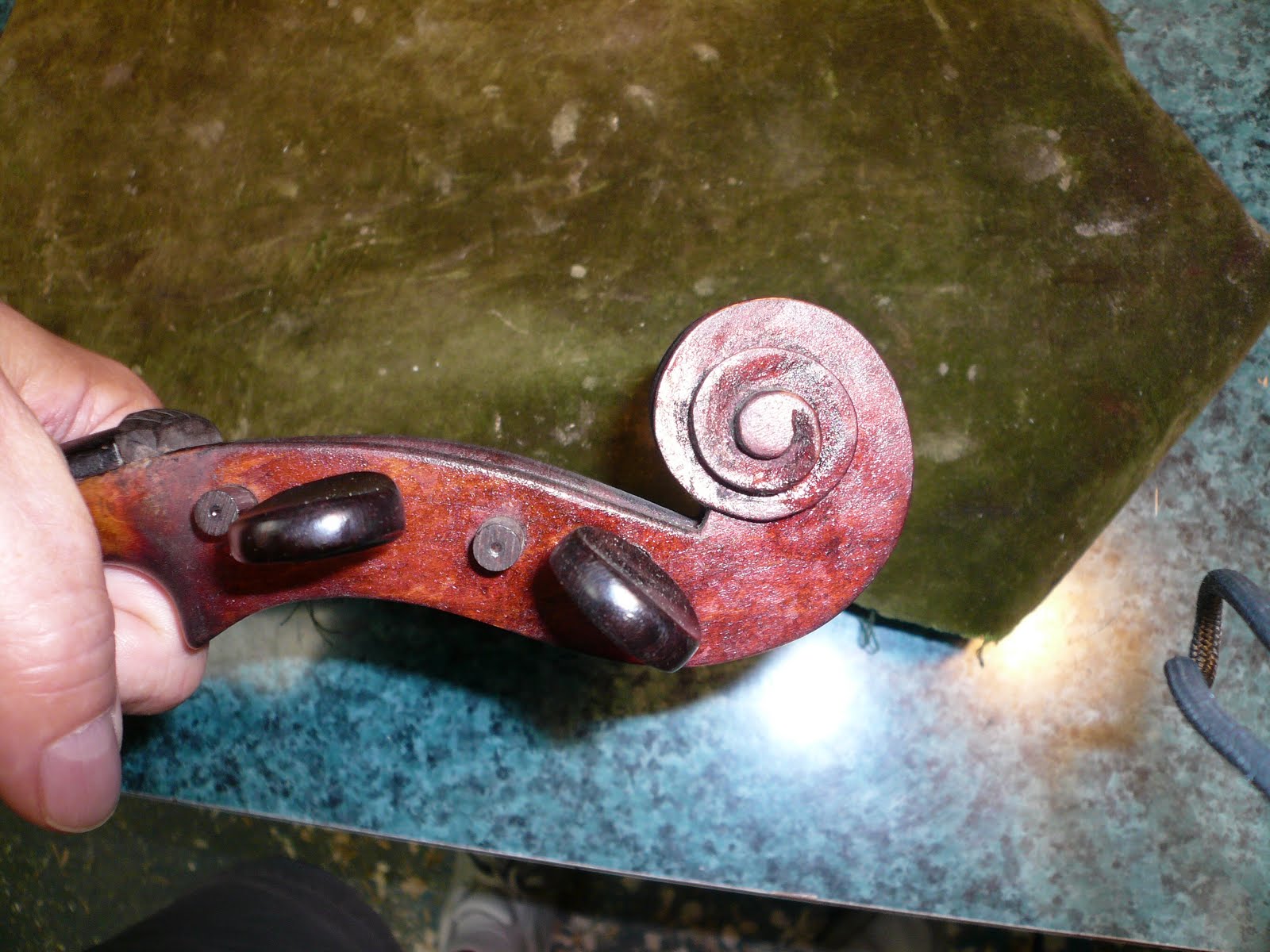
The neck, fingerboard and scroll appeared to be replacements constructed by a country fiddle maker. The scroll photo below shows the fairly crude carving consistent with American folk fiddle construction. 

After leaving the fiddle in my closet for a few months I spoke to Ben Parrott one morning and he asked about the fiddle.  In spite of great expense that would be entailed in doing a restoration it seemed a shame to just hang it on the wall and let even more structural damage occur to it over the years.  Ben suggested that if I was willing to invest the funds he would be willing to remove the top plate to better assess what if any parts of the violin might be salvaged.  Given that Ben believed the age of the top and bottom plates to be 200 years old or more, it had occurred to us that the two plates might be used in construction of a violin setup as they were in the Baroque period.  I thought it would be great fun to play my favorite music and composers on an instrument that could produce the sound as it was when the music was first composed and performed.

To do the assessment Ben first removed the chin rest and pried/popped off the fingerboard from the neck.  The glue was very dry and brittle so it came off very easily.  


Ben found an opening between th etop plate and ribs and inserted a dull blade to begin wedging the plate apart moving carefully around the entire body.


At points where the glue appeared to be resistent or carpenter's glue had been used he applied a few drops of alcohol which when dry cool the glue and make it more brittle and easily broken.


Eventually he worked he way around the fiddle and lifted the plate starting at the bottom by the end button.

Below is the violin with top plate removed side-by-side with the inside of the back exposed. 


I asked Ben to take some measurements of the plates for future reference.
The back plate: 
length - 350.5 mm
lower bout width - 200 mm
upper bout width - 159.5 mm
width between C-bouts - 112 mm
maximum thickness center - 5.2 mm
minimum thickness upper corners - 2.5 mm

The top plate:
maximum thickness center between upper eyes of the F-holes - 5.1 mm
minimum thickness at the upper corners - 2.7 mm

Below repairs to the top plate are evident and may have been done by a skilled luthier who penciled in on the top, Repaired 1929 By Joseph Benjamin of Brigsdale, Ohio ( a suburb of Columbus).


Below Ben is splitting the corner blocks as he intends to eventually remove the ribs from the back plate completely.


Below Ben is soaking the label and the neck joint with water to soften and remove them.


Above and below Ben is splitting the neck joint to remove the neck easily.  

The remaining part of the joint will be easier to remove later.


The Assessment Verdict.

Ben believes the the two plates and all but the replacement rib can be restored and used as the basis for a Baroque violin.  A new neck with scroll, baroque finger board, replacement upper bass rib and new bass bar will need to be carved by Ben.  The maple ribs will need to be re-bent to better match the curve of the top and bottom plates.  Cracks will have to be repaired or re-repaired.  In order to improve the sound Ben proposes to re-graduate the the two plates.  Measurement of the plate thickness verified that the plates were nearly twice as thick as those of the great Stradivari and Guarnari instruments of the same period.  He will reduce the thickness of the plates consistent with the Italian masters.  Finally, the instruments will require cleaning and application of replacement varnish to repair damage from the scraping done previously.  A Baroque bridge, new sound post, baroque style pegs and gut strings will complete the restoration.  Ben estimates the time involved will be approximately 60% of that required to build a new Baroque violin.

Friday, May 7, 2010

A Strad Inspired Violin - Log 5/7/2010

Friday May 7th, 2010
A Thank You from Haiti

The photos of the recipient of the Dr. Samuel W. Siurua Memorial Violin at Haiti's Holy Trinity School of Music are shown below.  Dr. Jean Montes with seven volunteers made the  trip to Haiti the last week of March delivering 60 instruments to replace those lost in the earthquake of January, 2010.  This was organized by Dr. Montes under the auspices of the Greater New Orleans Youth Orchestra of which he is Artisitic Director.  There were 15 instruments from Indianapolis including the violin finished by Benjamin Parrott in memory of Sam Siurua.  Dr. Montes personally carried Sam's violin with him on the trip to Port Au Prince and presented it to the recipient, Guerlyn Esperance. 

Guerlyn Esperance is the concertmistress of the orchestra and the leading Haitian violin teacher at the school where she began studies in the 3rd grade.  She began teaching at the music school in 1990 and at times has carried up to 30 private violin students in weekly lessons.  In addition to students and orchestral work Guerlyn leads a string quartet.  She has been trained as a teacher in the Suzuki method attending programs in Florida and Washington.  Her family is musical.  Her sister who is now living in the U.S. is a cellist and she often starts her day to the sounds of her father and brother singing.  She feels music has given her confidence and feels she is with family every day when she is teaching at Holy Trinity Music School.  She appreciates the many volunteers who have come to Haiti and wishes many more people would come to see and experience the Haiti as she knows it and loves it for it is very different from how it is often portrayed.


Below Dr. Montes presents the biographical sketch of Dr. Siurua's life to Guerlyn.


Here Dr. Montes is opening the violin case before presenting it to Guerlyn.

Then Guerlyn unwraps the violin from the silk bag protecting it.


Next Guerlyn sees the lovely instrument.

Guerlyn at last plays the Dr. Samuel Siurua Memorial Violin.

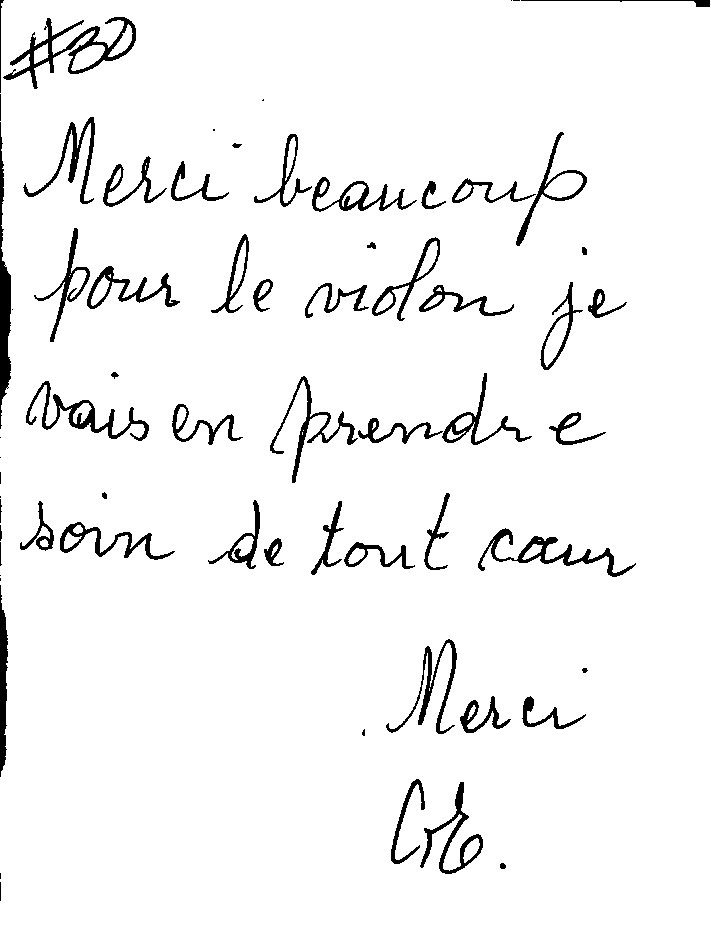
Below is a scan of Guerlyn's personal thank you note to the donors.

"Merci beaucoup pour le violon je vais en prendre soin de tout caur
Merci
GE"
This translate roughly to the following:

Thank you very much for the violin, I'll take very good care of everything, Thank you, GE

Below Dr. Montes in a personal letter offers his appreciation to all who have contributed to the Haitian Youth Music Relief Project.  As he says, "Mesi Anpril"(Thank you very much!).


Finally, I would like to also express my great appreciation to the following persons/organizations who contributed either with cash donations or in-kind donations making the violin, bows and accessories in Dr Siurua's memory possible:

Donna Lively Clark
Diantha De Graw
Frank's Violins (Mark Kurkowski)

Charles Hewett
Indianapolis Violins (Ted Skreko and Chris Ulbricht)

Robert and Leslie Kenny
Mary (Joie) Kipka
Benjamin Parrott

Thank you all very much.
Yours,
Jerry Allen


Wednesday, March 24, 2010

A Strad Inspired Violin - Log 3/22/2010

Monday March 22, 2010
GNOYO Office and Instrument Donations

Monday morning after my stay with the Montes family I returned to the Greater New Orleans Youth Orchestra office, 170 Broadway, so I could take the photos I missed the night before when I delivered the instruments from Indianapolis.

Dr Montes family is seen below with from left to right Jaz, Sarah and Soley.


Unfortunately, I missed the opportunity to capture a shot of Dr. Montes.  However Meriwether McGee forwarded the photo below of Dr. Montes with GNOYO board president, Katherine Cain and the beautiful "Dr. Samuel W. Siurua" memorial violin.


The GNOYO office sign is seen here.


The violin in Sam's memory was earlier presented to the administrator, Meriwether McGee with case and Jon Paul Bravo Carbon fiber bow seen below.


In this room the instruments from Indianapolis are being stored before inventoring and final packing.


In the next room inventoried, packed instruments await the trip to Florida from where they will be flown to Haiti.


GNOYO had 20 instruments inventoried and packed.  The 15 from Indianapolis brought the total on hand to 35.  Another shipment of possible a dozen or so should have arrived Friday and did not.  If it arrives in time it will be added to the 35 on hand to go to Florda  Otherwise it will need to wait for a later trip. 


Monday Afternoon
On to Pascagoula, Moss Point, Kreole, and Pecan

I left the GNOYO office and headed directly to Mississippi on I-10.  I wanted to meet with Renee Gautier-Hague of the Genealogy Department at the Pascagoula Public Library. 


She assisted me earlier by sending an electronic file of the Jackson county, MS. Siurua family history page which Sam had written and submitted to the library some years before.  I had previously sent her an uneditable electronic copy of Sam's biographical sketches but wanted to download a fully editable version with additions since his passing.  That would allow them to utilize any materials including photos independently.  Renee was extremely helpful providing references, maps and directions to try to locate Kreole and Pecan sites.

As I had driven into town I was elated to see that the Pascagoula  train station was still standing.  I had found a picture of Sam standing in front of it ready to head off to college in Chicago and wanted to see the building for myself.  It is now the location of the Singing River Art Association and owned by the city.  It is no longer serving Amtrak trains.


Thank you to Scotty Montague (left) and John Lynn (right) at the Moss Point Fire Station who provided excellent directions over to Kreole and Pecan after I lost my way the first time in Moss Point.  Scotty, I forgot to mention that Sam graduated from Moss Point High School in the 1930's.

Below are photos of the Kreole Finnish Luthern Church and Cemetery which I finally located on the opposite side of Highway 90 from where I had been searching. I located them only after Scotty gave me assistance.


Below is bayou near Pecan similar to that Sam said he had to cross to reach the gulf coast.


Sam's grandfather planted the Pecan grove pictured below behind their property when he moved there before Sam was born. Although overgrown, trees are still living.


Sam's home still stands but not for long.  It changed hands several times after Ada's death and now is apparently Federal property to be leveled as part of an Army Corps of Engineers improvement project.  I am still trying to determine details but Scotty believes it is part of a plan to reduce flooding in the area.

I am holding several branches from a rosebud azalea bush standing at the side of the house next to the porch.  It was so sad and disappointing to see the old homestead deserted, neglected and doomed for demolition.  I was so pleased to notice the beautiful blooming bush and pick the blooms to photograph and bring back as a remembrance.  Sam and his mother Ada so loved beautiful flowers.